

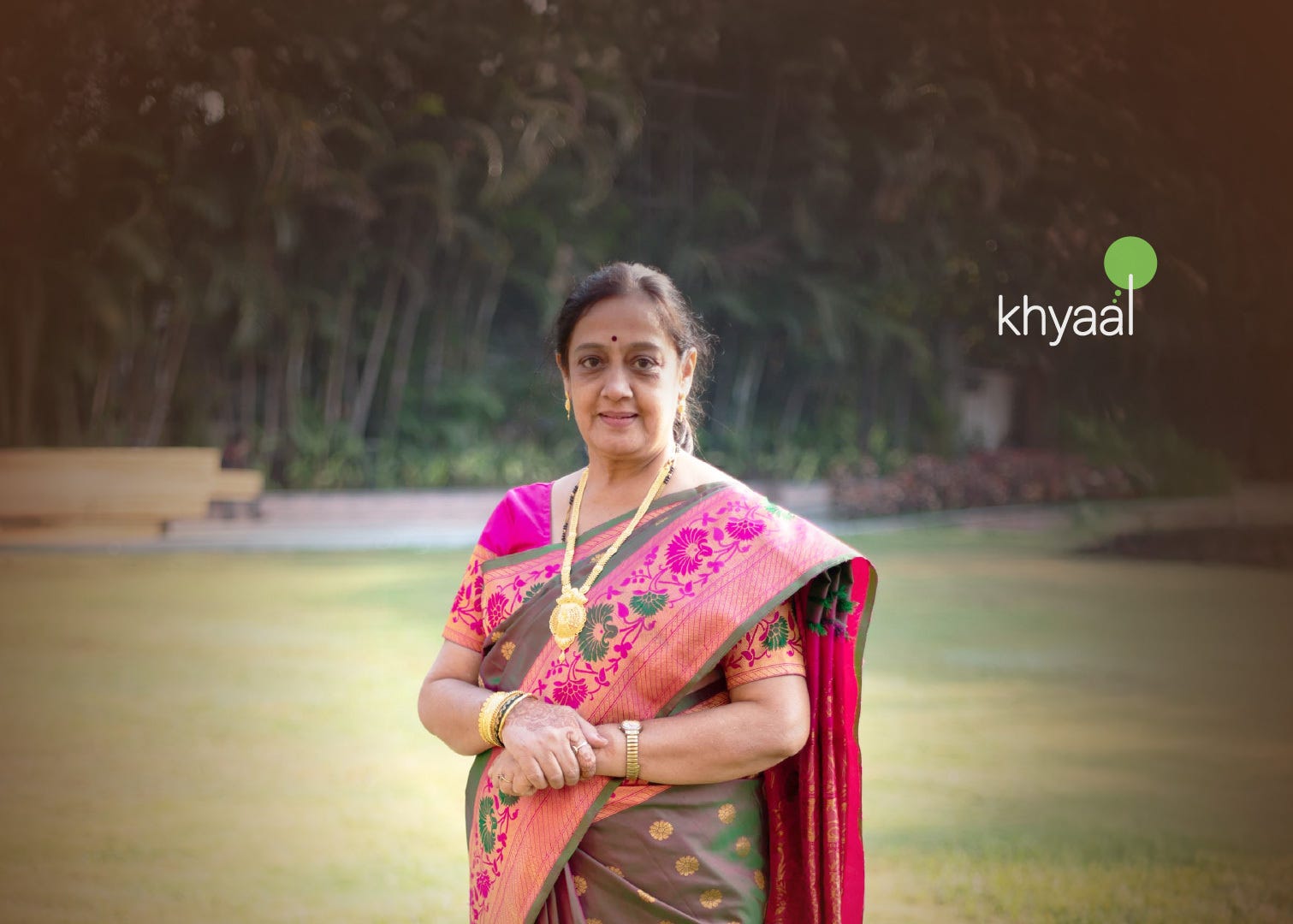
“My name is Manisha Ashok Date, and I am 62 years old. I was born and brought up in Mumbai. I completed my Bachelor’s Degree in Electrical Engineering from Mumbai University and soon entered the world of material handling equipment and special-purpose machines. I worked in this field for over 22 years, first in Mumbai and later in Pune after my marriage in 1990. My work became a big part of my life.
In 1994, while working in Pune, I took an entrepreneurial training course at Agricultural College through MCED. There, they taught us the basics of how to build something of your own. One session included a guest lecture on organic waste management. It was only one lecture, but something stayed with me. The thought that waste could be used to rebuild the soil and grow food felt meaningful, especially because of what I was seeing around me.
There was a garbage dumping corner right near the entrance of my society. Hotels, households, everyone used to throw waste there. Each time I entered my lane, the foul smell bothered me. I knew I could not watch silently. I went to the waste management office and took guidance. I distributed garbage bags within my society’s premises so that every household could collect and dispose of waste responsibly. People were cooperative. They started packing their waste properly, and we even arranged for someone to collect it daily. But a bigger problem appeared when a few nearby hotels quietly dumped their garbage at our gate every night. I felt this was unfair and disrespectful, so I approached them. I told them clearly, “To keep your place clean, you cannot dirty mine- this is a criminal offence.” I also reminded the health department of the corporation that these hotels were paying commercial taxes to run their business. So, the waste disposal was partly their responsibility too. If garbage was left unattended, it would attract flies, create a foul smell, and even affect business for these hotels. Whether it was my firmness or my awareness towards cleanliness that worked, but soon the officer arranged a proper waste collection system. Within one month, the entire dumping spot was cleared. The entrance was clean, and flowers and a sense of pride returned. That was the first moment when I truly felt that one person can create change.
Whatever I learned there, I tried at home. That is how I started a small terrace garden. I made a 20-feet-by-3-feet brick bed. I filled it with coconut shells, and every day I put our kitchen waste into it. After some time, tiny papaya plants started coming up on their own. I still remember the joy I felt when I saw them. Within one year, we harvested 54 papayas from those plants. They grew from the waste of my own home. It felt like nature was talking to me. Gradually, my terrace filled with fruits and vegetables. I never used any chemicals or pesticides, not even once. And this is how it became my joy and learning space. For thirty-one years, that garden stayed healthy and full of life. This garden still has a very special place in my heart.
With time and experience, I realised that waste management was not just my personal interest. It was a responsibility towards the environment and towards the people around me. In the early years, I guided my neighbours and nearby homes on how they could manage their kitchen waste in a simple way. But slowly, this small effort grew into real work, and I eventually started giving consultancy through my company ‘Soilink Waste Management’. I worked with apartments, bungalows, hotels, corporates and even organisations like Parle Products and Nivara Vridhashram. Each place had a different kind of waste depending on the kitchen, the land, and the people. I designed systems that helped them turn the waste into something useful - whether it was flour waste from factories, expired pet food, or even waste from butcher houses. When a person uses their own waste wisely, it also makes it easier for the Municipal corporation. But that is not the real aim. The real aim is to use your own waste for your own good, just like I did when I used it to grow fruits and vegetables for my family.
As my learning grew, so did my desire to build something large. I learned how to grow food without chemicals, how to balance soil nutrition and how to compost naturally. By the time I was 59, I felt ready to expand this into a bigger platform. This is how ‘Urban Bagaiti’ was born. I had some land on NDA Road in Pune. My years of practice, my terrace garden learning and my consultancy experience all came together here. I turned the space into the ‘Urban Bagaiti Demonstration Centre’, a place where people can come, learn and experience not only sustainable but also productive gardening practices. I designed the entire layout myself. I planned the rooms, the storage, the nursery area, and the entire flow of activity. I wanted the place to be practical and educational. So, I decided that the centre would show two different models. One model shows how vegetables can be grown organically in natural soil. The other model shows how vegetables can be grown without soil on cemented surfaces. Farmers usually have open land but lack exposure to organic methods, while urban residents have the interest but no soil. Urban Bagaiti became a bridge between both.


Once the land was organised, I began the actual work. And slowly, I understood how the space could be used better. I moved vegetables such as ladyfinger and beans that do not need support to the corners. Creepers such as cucumber, gourd and tomato were moved in the centre where they could grow on trellises. Leafy vegetables such as spinach were grown below. This created a multilayer farming system that helped us save space and produce more. Today, we grow 32 types of vegetables. We also created a nursery for saplings of vegetables, fruits and flowering plants. We prepare our own manure from cow dung and enrich it with natural additions like ash. We also make our own root growth liquid, organic tonics and a plant stress reliever from spinach. Along with this, we cultivate strawberries and also have a large number of rose plants, which bloom in abundance. These roses are used to prepare fresh, homemade gulkand. Everything is produced in house. Visitors can see how everything works in real time.
Urban Bagaiti also functions as a training and learning space. We have a small presentation room where I have meetings and conduct sessions for individuals, corporates, canteen operators and even municipal bodies. They learn about different types of waste, how to convert mono waste and mixed waste, and how to follow a proper schedule for organic growth. Once the session is over, they step outside the room and immediately see the live demonstration. This helps them understand how to apply the methods in their own city, farm or organisation. This practical learning model also supports our revenue through training, saplings, organic manure and some produce.


People often ask me how I found the market for my products, and honestly, the journey has been very natural. I have been part of a few lovely communities on WhatsApp, and through these groups, many people got to know about the work I do. Gradually, people in and around my area started recognising us as a place where you can find almost everything related to composting, gardening and natural farming. Over the years, they simply began reaching out to me directly. Along the way, I also created my own website, ‘Urban Bagaiti’. It is fully ready, and once the construction work in our building is completed and we add the final photographs, it will officially go live.
Today, Urban Bagaiti is my full-time commitment. I spend the day observing plants, planning new batches, preparing mixtures, managing the nursery and guiding visitors. Every day brings new activity, whether it is harvesting, preparing new soil beds or creating space for the next season. Many people expect things to slow down at this age. For me, this project has done the opposite. It has given me a new kind of energy. It keeps me active in the most fulfilling way. I even wound down my terrace garden because my time and devotion now completely belongs to Urban Bagaiti. It has become my second home, a place I nurture with my own hands. It is a dream I continue building each day with the same excitement I felt when I saw my first papaya plant.
In this phase of life, where work has changed its meaning and purpose feels clearer, I also found a community that understands seniors like me. I was thrilled when I got involved with Khyaal and the 50 Above 50 initiative. It felt wonderful to have a platform to share our passions, achievements, and stories. Khyaal has created a space where people of our age can learn, connect and grow. I truly feel such communities keep our minds young, our hearts active, and our spirits curious.
To everyone in their senior years, I would like to say one thing. If you have a passion, nurture it like a seed. We have lived enough to know what truly matters. Use that knowledge and create something. The satisfaction that comes from growing something with your own hands or building something for society is priceless.” - Manisha Ashok Date (Khyaal Club Member)
Unusual interest. Loved to read in detail. You are providing gift to the nature. Great ! The world needs such people like you. You are saving our environment. Keep the work up ! God bless you 🙏
उत्कृष्ट कार्य..